
MOBILE UX · INTEGRATIONS · PLUG-IN
Postgraduate students were already using music to focus, regulate mood, and unwind. We explored what happens when the listening experience actively supports those intentions instead of simply serving the next song.
Postgraduate students were already using music to focus, regulate mood, and unwind. We explored what happens when the listening experience actively supports those intentions instead of simply serving the next song.
Role: UX Researcher + Product Designer · Duration: 5-6 weeks
Discover . Context & problem space

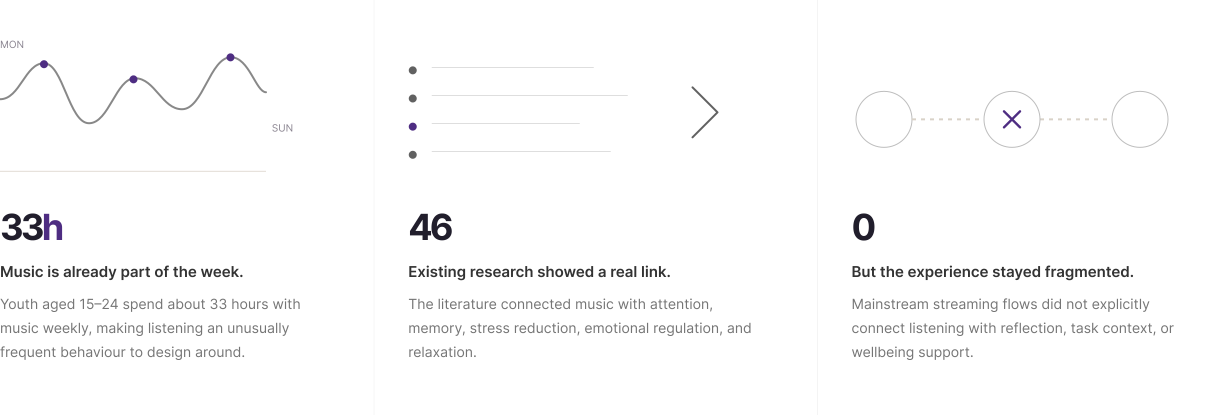
The opportunity was not to create a new habit. It was to make an existing one more intentional.
The opportunity was not to create a new habit. It was to make an existing one more intentional.
The opportunity was not to create a new habit. It was to make an existing one more intentional.

Discover . Research & Observations
Research only became useful when it changed a design decision.
Research only became useful when it changed a design decision.
Research only became useful when it changed a design decision.
We ran a mixed-methods study across six stages, from framing research questions to a 17-person post-prototype evaluation. My role touched every layer: synthesizing what we found, defining what the product should do, building the prototypes, and testing whether they actually worked.
We ran a mixed-methods study across six stages, from framing research questions to a 17-person post-prototype evaluation. My role touched every layer: synthesizing what we found, defining what the product should do, building the prototypes, and testing whether they actually worked.

Every method fed forward. The literature shaped what we listened for. The interviews surfaced what students actually do with music, not what they say they do. The themes told us what the product had to be. Nothing in here was research for its own sake.
Every method fed forward. The literature shaped what we listened for. The interviews surfaced what students actually do with music, not what they say they do. The themes told us what the product had to be. Nothing in here was research for its own sake.

Define . Thematic analysis & product framing
Eight coded themes became three jobs the product had to do well.
Eight coded themes became three jobs the product had to do well.
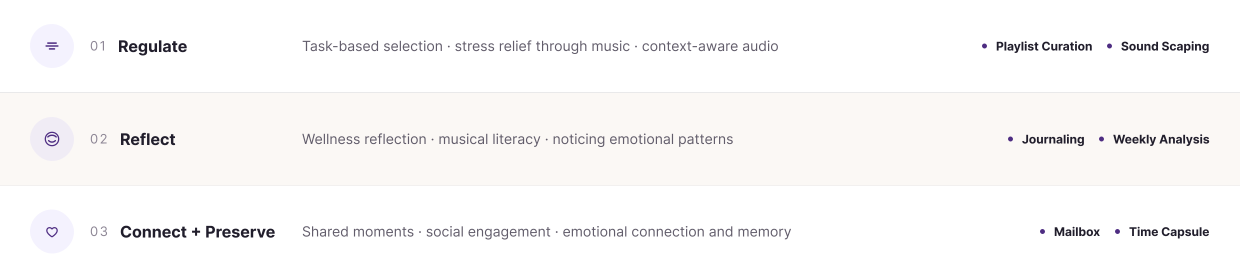
Eight themes, three jobs. Regulate a moment. Reflect on a pattern. Connect a feeling to something worth remembering. The product had to do all three without asking students to think about which one they needed.
Eight themes, three jobs. Regulate a moment. Reflect on a pattern. Connect a feeling to something worth remembering. The product had to do all three without asking students to think about which one they needed.
Define . Persona & journey map
Define . Persona & journey map
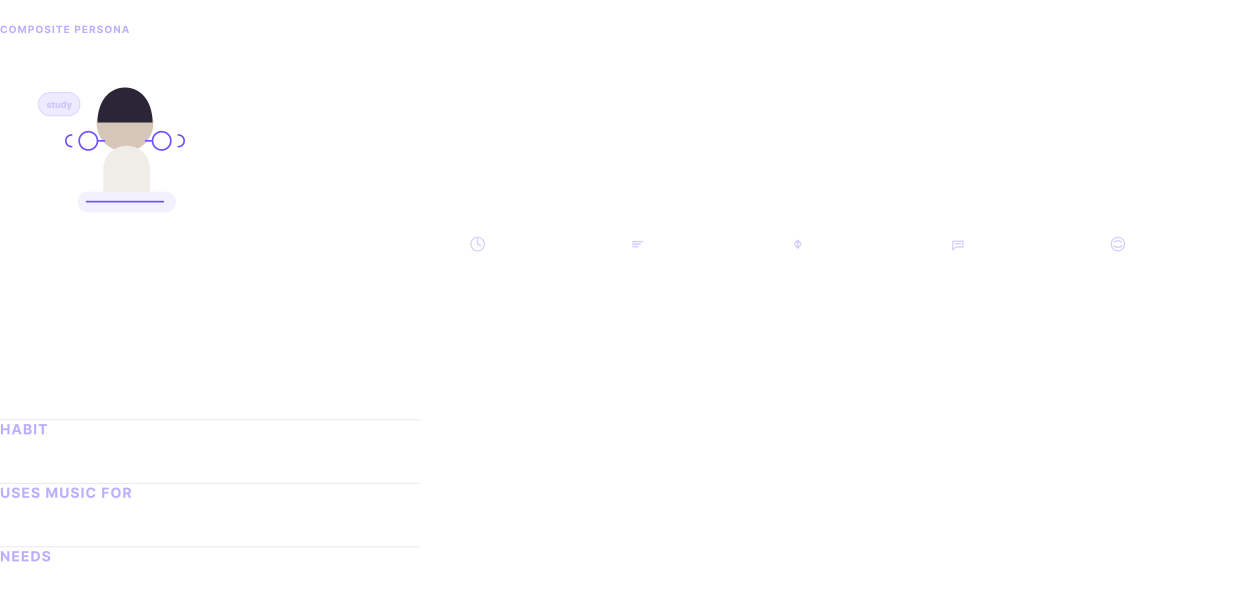
Carlos did not need more music. He needed more intention around the music he already used.
Carlos did not need more music. He needed more intention around the music he already used.
Carlos did not need more music. He needed more intention around the music he already used.
The Design Principle
The Design Principle
Research grounding: Obendorf's four dimensions of minimalism × Sweller's Cognitive Load Theory.

Design . Early Explorations
Before the polished prototype, I explored how much support should live around the music.
Before the polished prototype, I explored how much support should live around the music.
Before the polished prototype, I explored how much support should live around the music.
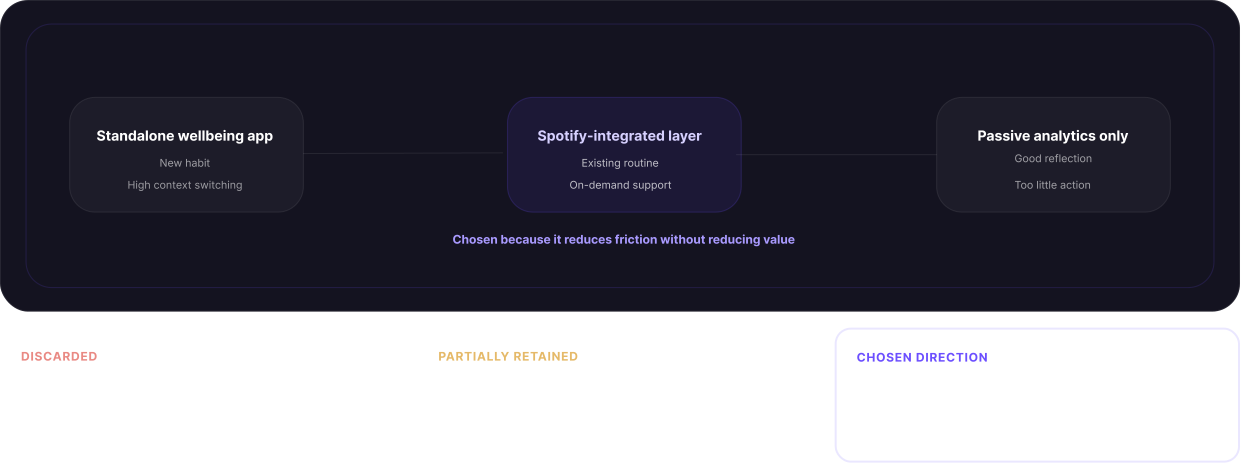
Early sketches ruled out two directions fast: too passive meant the product had nothing to offer, too active meant it became another thing demanding attention. The final concept lives in the gap, present when a student wants it, invisible when they don't.
Early sketches ruled out two directions fast: too passive meant the product had nothing to offer, too active meant it became another thing demanding attention. The final concept lives in the gap, present when a student wants it, invisible when they don't.
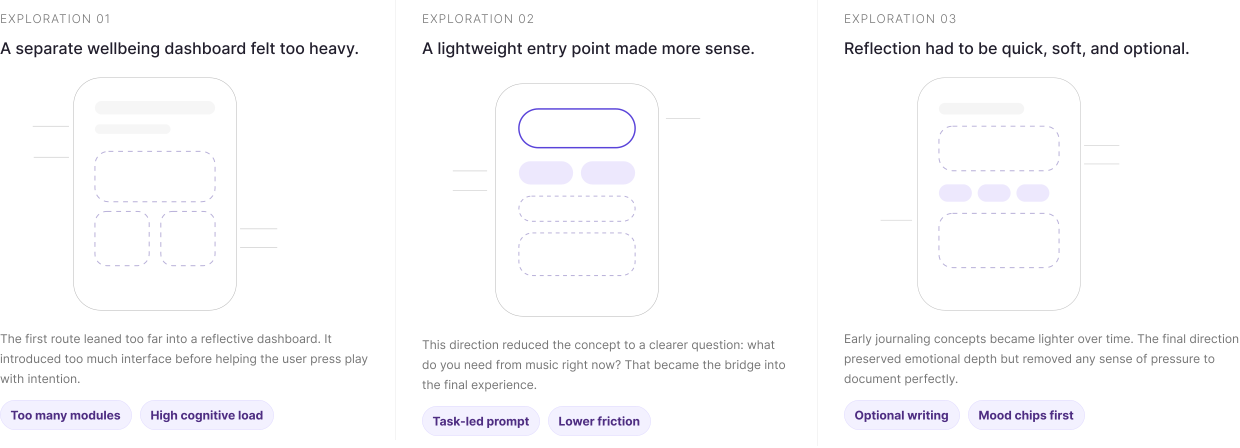
What changed through early explorations
What changed through early explorations
What changed through early explorations

Design . Product Overview
Six features, but one mental model: what do you need from music right now?
Six features, but one mental model: what do you need from music right now?
Six features, but one mental model: what do you need from music right now?
Six features, but one mental model: what do you need from music right now?

HOME + NAVIGATION
The home screen is a dashboard, not a player.
The home screen is a dashboard, not a player.
The home screen is a dashboard, not a player.
The concept extends Spotify rather than recreating it. Listening remains persistent while SoundMind's tools sit one layer above it, available when a student wants to act with more intention.
No onboarding. No training session. No existing mental model. Analysts arrive at a completely new interface and it has to be
immediately comprehensible.

REGULATE . TASK + MOOD-AWARE LISTENING
Reduce the effort between “I need to focus” and pressing play.
Reduce the effort between “I need to focus” and pressing play.
Reduce the effort between “I need to focus” and pressing play.
Both features start with context rather than music taste: one builds around a task; the other builds an environment
Both features start with context rather than music taste: one builds around a task; the other builds an environment
FEATURE 01 . PLAYLIST CURATION
Music that knows what you're trying to do.
Music that knows what you're trying to do.
Music that knows what you're trying to do.
Early versions gave users a blank starting point and asked them to decide genre, mood, tempo, and duration before hearing anything. Four taps replaced all of that- task type, energy level, duration, and play. Context first, music second.
Early versions gave users a blank starting point and asked them to decide genre, mood, tempo, and duration before hearing anything. Four taps replaced all of that- task type, energy level, duration, and play. Context first, music second.
Key Decision
Pre-built task tags replaced a blank starting point. Users still control the result, but they never face an empty input.
Pre-built task tags replaced a blank starting point. Users still control the result, but they never face an empty input.
Pre-built task tags replaced a blank starting point. Users still control the result, but they never face an empty input.

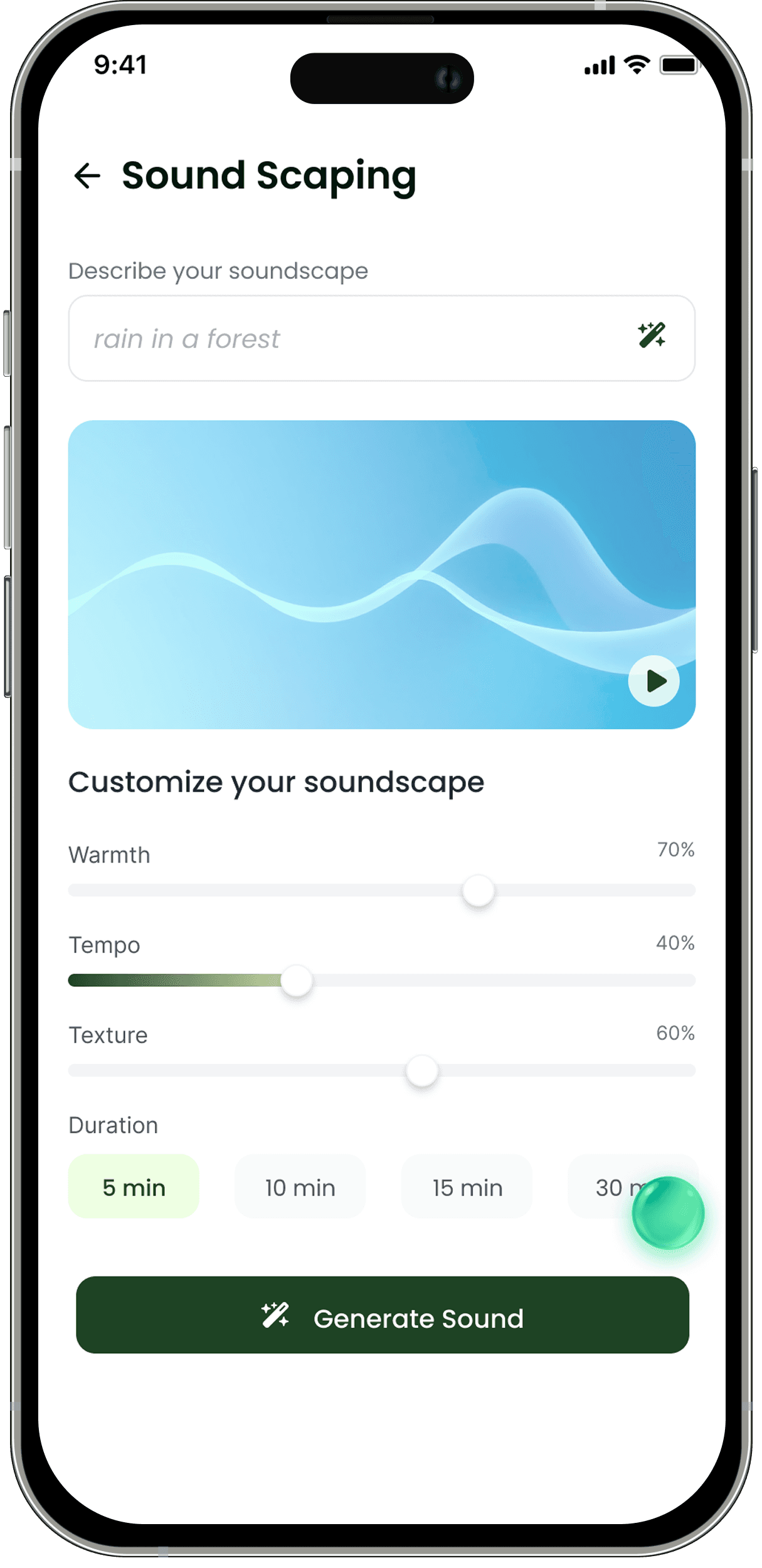
FEATURE 02 . SOUND SCAPING
Describe your environment. Hear it come to life.
Describe your environment. Hear it come to life.
Describe your environment. Hear it come to life.
Participants described music as fluid, environmental, and companion-like, not a selection, but a presence. The feature reflects that: a text prompt generates an ambient soundscape with three controls. You describe what you need. The environment builds itself.
Participants described music as fluid, environmental, and companion-like, not a selection, but a presence. The feature reflects that: a text prompt generates an ambient soundscape with three controls. You describe what you need. The environment builds itself.
Participants described music as fluid, environmental, and companion-like, not a selection, but a presence. The feature reflects that: a text prompt generates an ambient soundscape with three controls. You describe what you need. The environment builds itself.
Key Decision
A generative visualisation moves with the soundscape, signalling that the
environment is created from the user's prompt rather than chosen from a
preset.
A generative visualisation moves with the soundscape, signalling that the environment is created from the user's prompt rather than chosen from a preset.
A generative visualisation moves with the soundscape, signalling that the environment is created from the user's prompt rather than chosen from a preset.
A generative visualisation moves with the soundscape, signalling that the environment is created from the user's prompt rather than chosen from a preset.
REFLECT . MOMENTS + PATTERNS
Reflection should feel like noticing, not grading yourself.
Reflection should feel like noticing, not grading yourself.
Reflection should feel like noticing, not grading yourself.
Reflection should feel like noticing, not grading yourself.
Every word in these screens was chosen to describe, not evaluate. Patterns surface as observations. Nothing scores your week or tells you how you should have felt.
Every word in these screens was chosen to describe, not evaluate. Patterns surface as observations. Nothing scores your week or tells you how you should have felt.
FEATURE 03 . JOURNALING
Log the moment. Let the music remember it too.
Log the moment. Let the music remember it too.
Log the moment. Let the music remember it too.
A journal entry stays tied to the song that was playing when you wrote it. Six months later, the song doesn't just remind you of the moment, it carries it.
A journal entry stays tied to the song that was playing when you wrote it. Six months later, the song doesn't just remind you of the moment, it carries it.
A journal entry stays tied to the song that was playing when you wrote it. Six months later, the song doesn't just remind you of the moment, it carries it.
Key Decision
Mood chips reduce input effort and give users a quick emotional vocabulary before they decide whether to write anything.
Mood chips reduce input effort and give users a quick emotional vocabulary before they decide whether to write anything.
Mood chips reduce input effort and give users a quick emotional vocabulary before they decide whether to write anything.


FEATURE 03 . WEEKLY ANALYSIS
A mirror for your musical mind.
A mirror for your musical mind.
A mirror for your musical mind.
Listening patterns and journal entries are woven into a weekly narrative, written in plain language, tied to real moments, and framed around what you noticed rather than what the data scored.
Listening patterns and journal entries are woven into a weekly narrative, written in plain language, tied to real moments, and framed around what you noticed rather than what the data scored.
Listening patterns and journal entries are woven into a weekly narrative, written in plain language, tied to real moments, and framed around what you noticed rather than what the data scored.
Key Decision
No negative framing. The report describes patterns without labels like “bad week” or “too stressed,” keeping emotional data informative rather than judgmental.
No negative framing. The report describes patterns without labels like “bad week” or “too stressed,” keeping emotional data informative rather than judgmental.
No negative framing. The report describes patterns without labels like “bad week” or “too stressed,” keeping emotional data informative rather than judgmental.
CONNECT + PRESERVE . MEANING BEYOND PLAYBACK
Give a song back the context that made it matter.
Give a song back the context that made it matter.
The first four features are about what music does for you in the moment. These two are about what music means, to someone else, or to a future version of yourself.
The first four features are about what music does for you in the moment. These two are about what music means, to someone else, or to a future version of yourself.
FEATURE 05 . MAILBOX
When words fall short, send a song instead.
When words fall short, send a song instead.
Sending someone a song without context is a guess. Mailbox pairs the song with a note so the person receiving it understands what you meant, not just what you listened to.
Sending someone a song without context is a guess. Mailbox pairs the song with a note so the person receiving it understands what you meant, not just what you listened to.
Sending someone a song without context is a guess. Mailbox pairs the song with a note so the person receiving it understands what you meant, not just what you listened to.
Key Decision
The inbox previews enough to feel personal, but keeps the full note hidden until opening so the interaction still carries anticipation.
The inbox previews enough to feel personal, but keeps the full note hidden until opening so the interaction still carries anticipation.
The inbox previews enough to feel personal, but keeps the full note hidden until opening so the interaction still carries anticipation.


FEATURE 06 . TIME CAPSULE
Seal a moment. Let your future self open it.
Seal a moment. Let your future self open it.
Seal a moment. Let your future self open it.
Songs and notes are packaged into a visible but locked object, turning waiting into part of the emotional experience.
Songs and notes are packaged into a visible but locked object, turning waiting into part of the emotional experience.
Songs and notes are packaged into a visible but locked object, turning waiting into part of the emotional experience.
Key Decision
Different physical metaphors, box, cassette, tin, make the capsule feel
owned before it is filled and strengthen the sense of memory as an object.
Different physical metaphors, box, cassette, tin, make the capsule feel owned before it is filled and strengthen the sense of memory as an object.
Different physical metaphors, box, cassette, tin, make the capsule feel owned before it is filled and strengthen the sense of memory as an object.
Deliver . Prototype Testing & Results
What users actually wanted to keep.
What users actually wanted to keep.
What users actually wanted to keep.
17 SUTD postgraduate students evaluated all six features across three prototype rounds. The question wasn't whether they liked it, it was whether they'd actually use it, and whether it made them feel any differently about how they listen.
17 SUTD postgraduate students evaluated all six features across three prototype rounds. The question wasn't whether they liked it, it was whether they'd actually use it, and whether it made them feel any differently about how they listen.




Deliver . Reflection
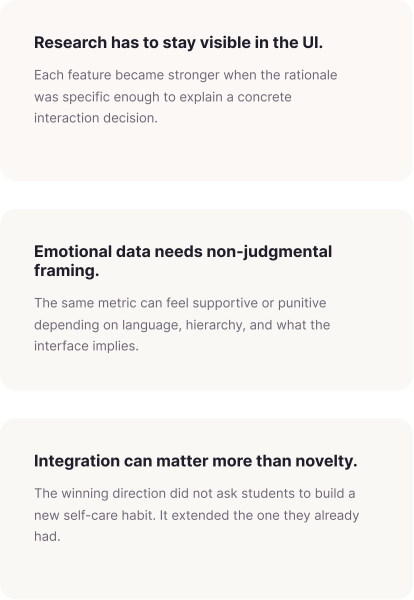
Designing for wellbeing changes the details that matter.
Designing for wellbeing changes the details that matter.

Discover . Research & Observations
Research only became useful when it changed a design decision.
My team combined background research, semi-structured interviews, thematic analysis, concept exploration, and prototype testing. I worked across research synthesis, product definition, prototyping, and evaluation.
My team combined background research, semi-structured interviews, thematic analysis, concept exploration, and prototype testing. I worked across research synthesis, product definition, prototyping, and evaluation.
Define . Persona & journey map
Carlos did not need more music. He needed more intention around the music he already used.
The Design Principle
Research grounding: Obendorf's four dimensions of minimalism × Sweller's Cognitive Load Theory.
Deliver . Prototype Testing & Results
What users actually wanted to keep.
After three prototype rounds, 17 SUTD postgraduate students evaluated the six feature concepts for appeal, intended use, and perceived wellbeing impact


